
















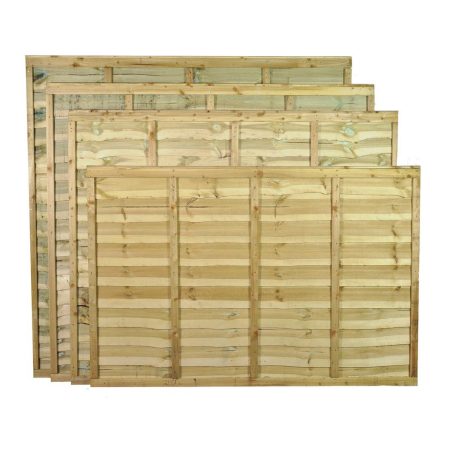

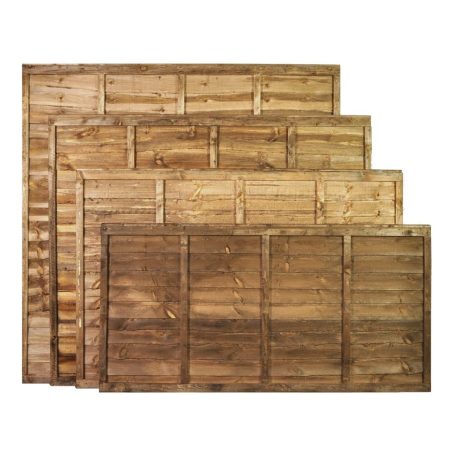
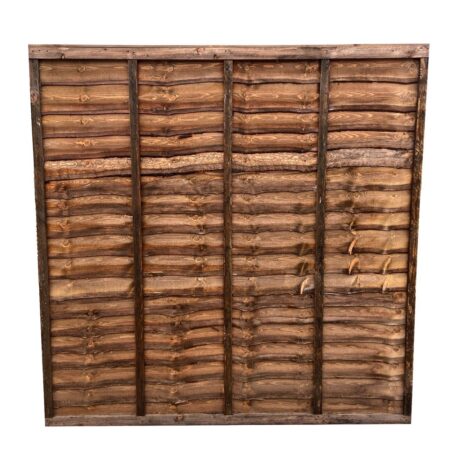
What is a lap fence panel?
A lap fence panel - also called an overlap panel - is a timber fence panel where horizontal slats are laid so that each one overlaps the one below, leaving no gaps. This gives full privacy across the full width of the panel. All our lap panels are 6ft wide and are available in heights from 3ft up to 6ft. We stock them in green treated and brown treated.
What posts do I need for lap fence panels?
Lap panels are designed to slot into or fix to posts spaced at 1.83 m (6ft) centres - matching the panel width. Concrete slotted posts are a common choice, as the panels slide directly into the slots. Timber fence posts work well too, with panels fixed by screwing through the frame or using panel clips. For posts set in the ground, allow a minimum of 600 mm below ground for fences up to 1.8 m, set in concrete or a post mix.
Should I use a gravel board with lap fence panels?
Yes - fitting a gravel board along the base keeps the bottom of the panel off the ground and away from soil and standing water. This significantly extends the life of the panel. Concrete gravel boards are the most durable option and are available in 6-inch and 12-inch heights; timber gravel boards are also an option if you prefer a fully wooden finish.
What is the difference between a lap panel and a closeboard panel?
Lap panels use thinner overlapping slats stapled or nailed to a timber frame - they are lighter, more affordable, and quick to install as a complete unit. Closeboard panels use heavier, individually fixed featheredge boards on a framed structure, which makes them stronger and more resistant to wind. For most residential garden boundaries, lap panels are a practical choice; closeboard is worth considering in exposed locations or where a longer service life is the priority.
How do I maintain lap fence panels?
The panels are pressure treated against rot, so ongoing maintenance is low. Applying a coat of fence paint or preservative every couple of years helps maintain the colour and adds a further layer of protection. Check fixings and the base of the frame each year - this is where moisture tends to collect first. A gravel board at the base reduces the rate of deterioration at the bottom rail considerably.